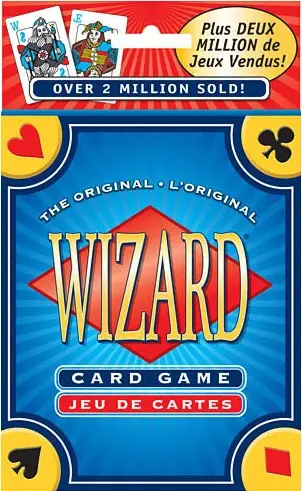
Created by Canadian game designer Ken Fisher, Wizard began as a variation on the classic trick-taking game Oh Hell. Fisher originally designed it as a game he could play with his wife, his young son, and other vacationers at his cottage. In 1986, he self-published the first 10,000 copies.
The main idea of the game is simple: before playing your cards, predict exactly how many tricks you will win. Get it right, and you earn points. Get it wrong, even by a single trick, and you lose points. What that means is a high card isn’t necessarily good. Sometimes you want to win a trick, while other times you desperately want to lose one. A high card might save your hand or ruin your carefully calculated bid by giving you a trick you never wanted. Wizard uses a standard deck as its foundation but adds four Wizards and four Jesters, creating a 60-card deck.
Wizard the card game requires a specialized deck. To purchase your own copy of Wizard, click here or see the bottom of this article for alternative purchase options. A standard game of Wizard includes:
That makes 60 cards total.
Wizard is designed for 3–6 players. The official game is generally recommended for ages 10 and up.
The goal is to finish the game with more points than anyone else.
The main objective in Wizard is to predict how many tricks you will win and then win exactly that many.
A trick consists of each player playing one card.
For example, if four people are playing, everyone plays one card. Those four cards make up one trick, and whoever wins that trick collects the cards.
Once everyone has played all their cards, the hand ends and players score points based on whether they made their predictions.
The catch is that you don’t simply want to win as many tricks as possible.
You want to win exactly as many as you predicted.
Choose a dealer.
The first dealer can be determined by dealing one card to each player. The player with the highest card becomes the dealer. The deal then moves clockwise after each hand.
Shuffle the entire 60-card deck before each hand.
The number of cards dealt changes throughout the game.
Hand 1
Each player receives 1 card.
Hand 2
Each player receives 2 cards.
Hand 3
Each player receives 3 cards.
And so on.
Continue increasing the number of cards by one each hand.
The number of hands depends on the number of players:
Number of Players | Total Number of Hands |
3 | 20 |
4 | 15 |
5 | 12 |
6 | 10 |
On the final hand, the entire deck is dealt.
This gradual increase is an important part of Wizard. Early hands give you very little information and very little control. As the hands get larger, you’ll have more cards to work with and more opportunities to make clever plays.
After the cards are dealt, flip the top card of the deck and place it on top.
This card determines the trump suit for the hand.
If a Heart is revealed, Hearts are trump. If a Spade is revealed, Spades are trump. And so on.
A trump card beats any card from the other suits.
Example:
Suppose Hearts are trump.
One player plays the King of Clubs.
Another player plays the 3 of Hearts.
Even though the King is much higher than the 3, the 3 of Hearts wins because Hearts are trump.
There is one important exception: Wizards.
We’ll get to those shortly.
On the final hand, all 60 cards are dealt, so there is no remaining card to determine trump. The final hand is played with no trump.
What if a Wizard is turned over?
If the card turned up to determine trump is a Wizard, the dealer chooses the trump suit after looking at their cards.
The dealer can choose any of the four suits, but cannot choose no Trump.
What if a Jester is turned over?
If a Jester is revealed, the hand is played with No Trump.
Before anyone plays a card, every player predicts how many tricks they expect to win.
This is called your bid.
If you’re dealt five cards, for example, you could bid anywhere from 0 to 5 tricks.
You aren’t required to bid at least one trick.
You can bid zero.
That means:
“I don’t think I’m going to win a single trick this hand.”
And if you’re successful, that’s worth points.
Your bid should be based on the cards in your hand, the trump suit, and the special Wizard and Jester cards.
Example
You are dealt:
If Spades are trump, you might expect to win two tricks with the Ace and King.
You could therefore bid 2.
But remember: winning three tricks isn’t better than winning two.
If you bid two and win three, you’ve missed your bid.
That’s one of the central strategic ideas behind Wizard.
The player to the dealer’s left plays the first card.
That player can play any card from their hand.
The other players then play one card each in a clockwise rotation, following the rules for the suit that was led.
You Must Follow Suit
If a player leads with a Club and you have at least one Club in your hand, you must play a Club.
You cannot play a Heart, Diamond, or Spade instead. Wizards and Jesters are exceptions to this rule and can be played at anytime
If you don’t have a card of the suit that was led, however, you can play another suit
If a Wizard card is played first, that card automatically wins the trick and players can put whatever card they want down. This can be a good opportunity to get rid of high cards, trump cards or Wizards if you have already made your tricks or think you will end up winning too many. Likewise, if you still have tricks to make, this can be a good time to get rid of low cards or jesters that will help the least in securing later tricks.
If a Jester card is played first, that is considered null and the next card played will be considered the leading suit. In the rare circumstance that every player plays a Jester, the first Jester wins the trick. Under any other circumstance, the Jester will never win a trick.
Example
Trump is Clubs and the first player plays the 8 of Diamonds.
You have:
Because you have a Diamond, you must play the 2 of Diamonds.
You cannot play the King of Clubs just because you think it would be a better play.
The first Wizard played always wins the trick.
Nothing can beat it.
Not an Ace.
Not a trump card.
Not another Wizard played later.
If multiple Wizards are played, the first Wizard played wins.
The highest trump card wins.
For example, if Hearts are trump:
The King of Hearts wins because it is the highest trump card.
The highest card of the suit that was originally led wins.
For example:
The Queen of Clubs wins.
The Heart doesn’t matter because Hearts weren’t led and, assuming Hearts aren’t trump, it cannot beat the Clubs.
The Wizard is the most powerful card in the game.
A Wizard:
This makes Wizards extremely useful, but using one isn’t always a good thing.
Suppose you bid 1 trick and already have a strong Ace that you expect to win later.
If you play your Wizard now, you are almost guaranteed to win this trick.
That might sound great.
But if you’ve already planned on winning one later, you’ve just won a trick you didn’t necessarily want.
Wizard isn’t simply about taking tricks.
It’s about controlling which tricks you take.
Jesters are essentially the opposite of Wizards.
A Jester:
They’re particularly useful when you want to avoid taking a trick.
Example
You bid 2 tricks.
You’ve already won two tricks.
There’s one more trick to play, and you don’t want to win it.
If you don’t have the suit that was led, playing a Jester can help you avoid taking the trick.
There is one unusual exception: if every card in a trick is a Jester, the first Jester played wins the trick.
As the game progresses, keep your tricks separate from the cards still in your hand. You can stack all the cards in the trick and put it on the table near you in separate stacks for each trick you’ve won, which helps everyone to be able to see how many tricks each player has won.
You can also use coins, tokens, or another marker to show each player’s bid and help everyone keep track. It is advisable to keep bids and tricks visible during play.
This becomes increasingly important as the number of cards increases.
Scoring is where Wizard becomes particularly interesting.
If you make your exact bid, you receive:
20 points + 10 points for every trick you bid
If you miss your bid, you lose:
10 points for every trick you were over or under your bid.
Example: Bid 0, Win 0
You bid 0 and win 0 tricks.
You made your bid exactly.
Score: +20 points
Yes, you can score points without winning a single trick.
Example: Bid 1, Win 1
You bid 1 and win exactly 1 trick.
You receive:
Score: +30 points
Example: Bid 3, Win 3
You correctly predicted three tricks.
20 points + 30 points =
+50 points
Example: Bid 4, Win 3
You predicted four tricks but only won three.
You’re one trick short.
Score: -10 points
You don’t receive the 20-point bonus because you didn’t make your exact bid.
Example: Bid 4, Win 5
You predicted four tricks but won five.
You’re one trick over.
Score: -10 points
This is one of the biggest adjustments new players need to make when learning Wizard.
Winning an extra trick can actually hurt you.
Example: Bid 5, Win 2
You’re three tricks short of your prediction.
Score: -30 points
The same applies if you bid 5 and win 8, although that example would only be possible in a sufficiently large hand.
Continue playing hands until the final hand is completed.
Add up everyone’s scores.
The player with the highest total score wins the game.
If two or more players finish tied for the highest score, the official rules provide a tiebreaker: the tied players draw cards to determine the dealer and then play a 10-trick tiebreaker round. Their bids are kept hidden until play is completed.
The rules of Wizard can be explained fairly quickly. Mastering the game is another story.
The key is learning that the strongest card isn’t always the card you want to play.
If you’ve already made your bid, you may want to avoid winning additional tricks. A Jester might suddenly become more valuable than an Ace. A low trump might be exactly what you need. And a Wizard, despite being the most powerful card in the deck, can sometimes be a liability. Sometimes an opponent playing their Wizard is the perfect chance to discard yours when you think you’re in danger of going over bid.
As the number of cards in each hand increases, players have more information to work with. You begin thinking not just about your own cards, but about what other players might have bid and which cards they’ve already played. Sometimes you have the opportunity to take a trick, but not doing so will wreck your opponents bid.
Wizard is a game that’s simple on its face but when diving deeper, there’s a lot more to it. The game combines strategy, prediction, and a little bit of luck. Theres also an element of reading your opponents. When combined with the wagering aspect, it gives it a bit of a poker feel.
The Wizard and Jester cards are a welcome addition to an otherwise standard deck. Wizards can win almost any trick, while Jesters typically lose, creating unexpected twists that can completely change the outcome of a round.
The rules are relatively easy to learn, making it accessible to casual players, but there is enough strategy to keep experienced players interested. The key is knowing when to bid aggressively, when to play conservatively, and how to read your opponents
Overall, Wizard is an entertaining choice for game nights, especially for players who enjoy competitive card games with simple rules and meaningful strategic decisions. It’s easy enough for newcomers to pick up while still offering plenty of depth for repeat play.
The current standard edition is a 60-card game for 3–6 players, with the Wizard and Jester cards that define the game. U.S. Games Systems also offers versions such as the Wizard Deluxe Edition, which includes plastic bidding wheels.
With simple rules, a relatively short setup, and enough strategic depth to keep experienced players interested, Wizard is a great addition to your next game night.
If you’re interested in trying Wizard for yourself, the game is published by U.S. Games Systems and is available for purchase:
If you enjoyed this article, sign up for our newsletter below to receive alerts when we release more content like this.
Added to cart
Check out our shop to see what's available
Loading coupons...