
In this guide, we will cover aspects of the Skyjo card game including:
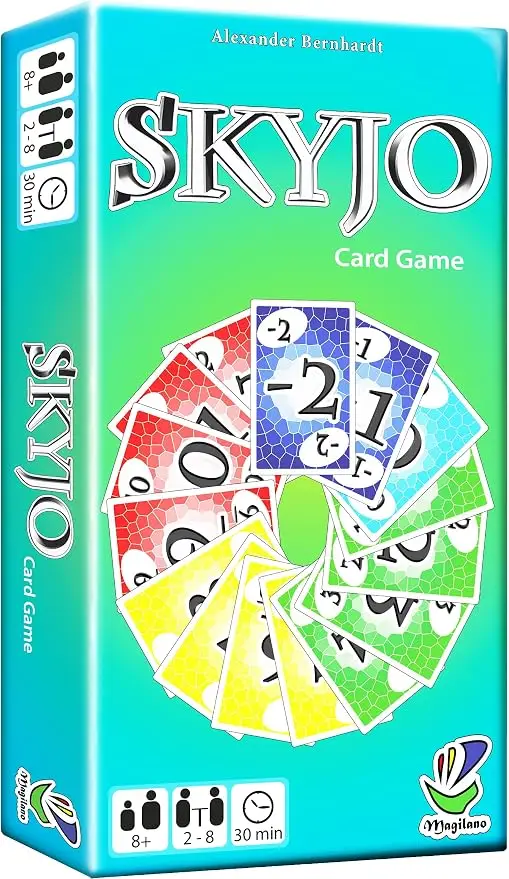
If you enjoy simple card games that combine luck, strategy, and a little friendly competition, Skyjo card game is an excellent choice for family game night. Designed by Alexander Bernhardt and published by Magilano, Skyjo challenges players to collect the lowest possible score by replacing high-value cards with lower ones.
The rules are easy to learn, making it a great option for casual gamers and families. However, deciding which cards to keep, which to replace, and when to end a round can make the difference between winning and losing.
Unlike traditional card games, Skyjo uses numbered cards arranged in a grid in front of each player. Throughout the game, you’ll reveal hidden cards, exchange cards, and look for opportunities to remove entire columns.
The goal is simple: finish the game with the fewest points.
Before starting, make sure you have everything ready.
Skyjo is best played with at least three players, although it works well with two. More players add variety and make it harder to predict when someone will end a round.
The Skyjo deck contains numbered cards ranging from -2 to 12. Each card’s number represents its point value.
Remember, the goal is to have the lowest score, so a card with a value of -2 is much better than a card worth 12.
To begin, shuffle the deck and deal 12 cards face down to each player.
Each player arranges their cards into a grid of three rows and four columns. All 12 cards remain face down initially.
Place the remaining cards face down in the center of the table to create the draw pile. Turn over the top card and place it beside the draw pile to start the discard pile.
Each player then turns over two of their own cards.
The player whose two revealed cards have the highest combined value goes first. Play continues clockwise.
On your turn, you have two options.
Take the face-up card from the discard pile and exchange it for one of your 12 cards.
You may replace either a face-up or face-down card in your grid. Place the replaced card face up on the discard pile.
If you replace a face-down card, you cannot look at it before deciding where to place the new card.
Take the top card from the face-down draw pile and look at it.
You now have two choices:
If you draw a card you don’t want, you can discard it and reveal a hidden card instead. This is a useful way to learn more about your grid without changing the position of your existing cards.
As the game progresses, you’ll gradually reveal your cards and replace high-value numbers with lower ones.
For example, imagine your grid contains the following cards:
| 12 | 8 | 3 | 1 |
| 7 | 5 | 0 | -2 |
| 10 | 4 | 6 | 2 |
Your grid has a total value of 56 points.
If you draw a 1 and replace the 12, your total drops to 45 points.
That’s an 11-point improvement from a single move.
The key is to keep looking for opportunities to replace high-value cards while avoiding unnecessary changes to cards that are already helping your score.
One of Skyjo’s most important rules involves removing columns.
If you reveal three cards of the same value in a vertical column, you can discard all three cards in that column.
For example, if all 3 cards in one column are 4’s, you remove the entire column from your grid.
Those cards no longer count toward your final score.
This rule makes matching columns particularly valuable. A column of three 10s would otherwise contribute 30 points, so removing it can dramatically improve your position.
Keep an eye on the cards in each column as you reveal them. Sometimes, keeping a card that matches two others can be more valuable than replacing it with a slightly lower number.
A round ends when one player has revealed all their cards.
However, the other players get one final turn before scoring begins.
After everyone has taken that final turn, all remaining face-down cards are revealed.
Each player adds up the values of the cards remaining in their grid. Any columns removed during the round are excluded.
The player with the lowest total has the best result for that round.
Note:The player who reveals all their cards first triggers the end of the round, but doing so comes with a risk.
If that player does not have the lowest score, their positive score for the round is doubled.
For example, if the player who ended the round scores 15 points but another player scores 12, the player who ended the round receives 30 points instead of 15.
This penalty makes timing important. You don’t want to end a round too early if your score is still higher than your opponents’ scores.
Note: The doubling rule applies to a positive score, not a negative score.
After each round, players record their scores and begin another round.
The game continues until at least one player reaches 100 points or more.
At that point, the game ends and everyone totals their accumulated points.
The player with the lowest overall score wins.
This means you don’t necessarily need to win every round. Consistently scoring fewer points than your opponents is usually the best path to victory.
Skyjo is easy to learn, but a few simple strategies can help you improve your results.
Your priority should usually be getting rid of cards worth 8+ points.
Replacing a 12 with a 3 saves you nine points. Replacing a 4 with a 2 only saves two.
When deciding between two possible exchanges, consider how many points each move could save.
Pay attention to which cards you’ve already revealed and where they are located.
If you have several face-down cards, think carefully before replacing one. You might already have a low-value card in that position.
As you learn more about your grid, you’ll have a better idea of which cards are worth keeping and which need to go.
Removing a column of three matching cards can save a substantial number of points.
For example, removing three 8s eliminates 24 points from your grid.
If you already have two matching cards in a column, consider whether keeping the third matching card could be worthwhile.
However, don’t hold onto a high-value card indefinitely while waiting for a match that may never come.
Revealing all your cards can give you control over when the round ends, but it can also backfire.
Before revealing your final card, consider how your score compares with what you know about your opponents’ grids.
If your score is already low, ending the round may be a good decision.
If you still have several high-value cards, it might be better to continue improving your grid.
It’s tempting to replace every card with something slightly lower, but not every move is worth making.
If you have a 2 and draw a 1, the improvement is only one point.
Sometimes, it may be better to keep a card that helps you complete a matching column or reveal a hidden card that could be worth much more.
The best moves are those that improve your overall position, not simply those that lower one card’s value.
Skyjo isn’t played in isolation. Your opponents’ grids can provide useful information.
If another player has only one hidden card remaining, they may be close to ending the round.
If their revealed cards already add up to a low score, you may need to act quickly to improve your own grid.
Watching other players can help you decide whether to keep improving your cards or prepare for the end of the round.
Skyjo is a game that combines luck as well as some decision making. The game reminds us of the classic card game golf, but the larger layout and points penalty for finishing first gives it a new twist that is a welcome addition.
Skyjo is easy to learn and works well for a wide range of players. Most people can understand the basic rules after a few turns, making it a good choice for introducing new players to card games.
The game also provides a satisfying balance between luck and decision-making. You can’t control which cards you draw, but you can decide how to use them.
We also like the matching-column rule. It creates opportunities for big score reductions and gives players something to work toward beyond simply replacing high cards.
Another advantage is the player count. Supporting up to eight players makes Skyjo a useful option for larger families and groups.
Finally, the card design is aesthetically pleasing, and the lack of face cards makes Skyjo more straightforward in regard to scoring than say playing golf with a standard deck.
Skyjo relies heavily on luck. Sometimes, one player gets a run of excellent cards while another struggles to replace high numbers.
The game can also feel repetitive after several rounds, particularly for players who prefer games with more complex decisions or direct interaction between opponents.
Because players mostly focus on their own grids, there isn’t as much player interaction as you’ll find in some other games.
Yes. The basic rules are straightforward, and the game doesn’t require players to memorize complicated combinations or special abilities.
New players may need a round or two to understand the best ways to manage their cards, but most people should pick it up quickly.
Skyjo has solid replay value as a casual card game.
The random card draws make each round different, and the relatively short playing time makes it easy to play multiple games in one sitting.
It works particularly well as a family game or as a quick activity when you want something competitive without a lengthy setup.
Skyjo is a good fit for:
Players who prefer deep strategy, extensive player interaction, or games with little luck may find Skyjo less appealing.
Skyjo is an enjoyable card game that combines simple rules with enough decision-making to keep players interested.
Its biggest strength is its accessibility. You can teach it quickly, play with a variety of ages, and enjoy a competitive game without spending a long time setting everything up.
Although luck plays a significant role, decisions about which cards to replace, when to pursue matching columns, and when to end a round add a worthwhile strategic element.
Our verdict: Skyjo is a great choice for families, casual gamers, and anyone looking for an easy-to-learn card game. It’s especially appealing if you enjoy games that reward careful decisions without requiring hours of practice.
If you’re looking for a simple game to bring to your next family gathering or game night, Skyjo is worth considering.
Now that you know how to play Skyjo, you may be wondering where to buy it. You can look for Skyjo at major retailers, local game stores, and online marketplaces.
Heres a link to purchase from their official Amazon Page
Enjoyed this post? Sign up for our newsletter below to get more game guides, recommendations, tips, and inspiration for your next game night!
Added to cart
Check out our shop to see what's available
Loading coupons...