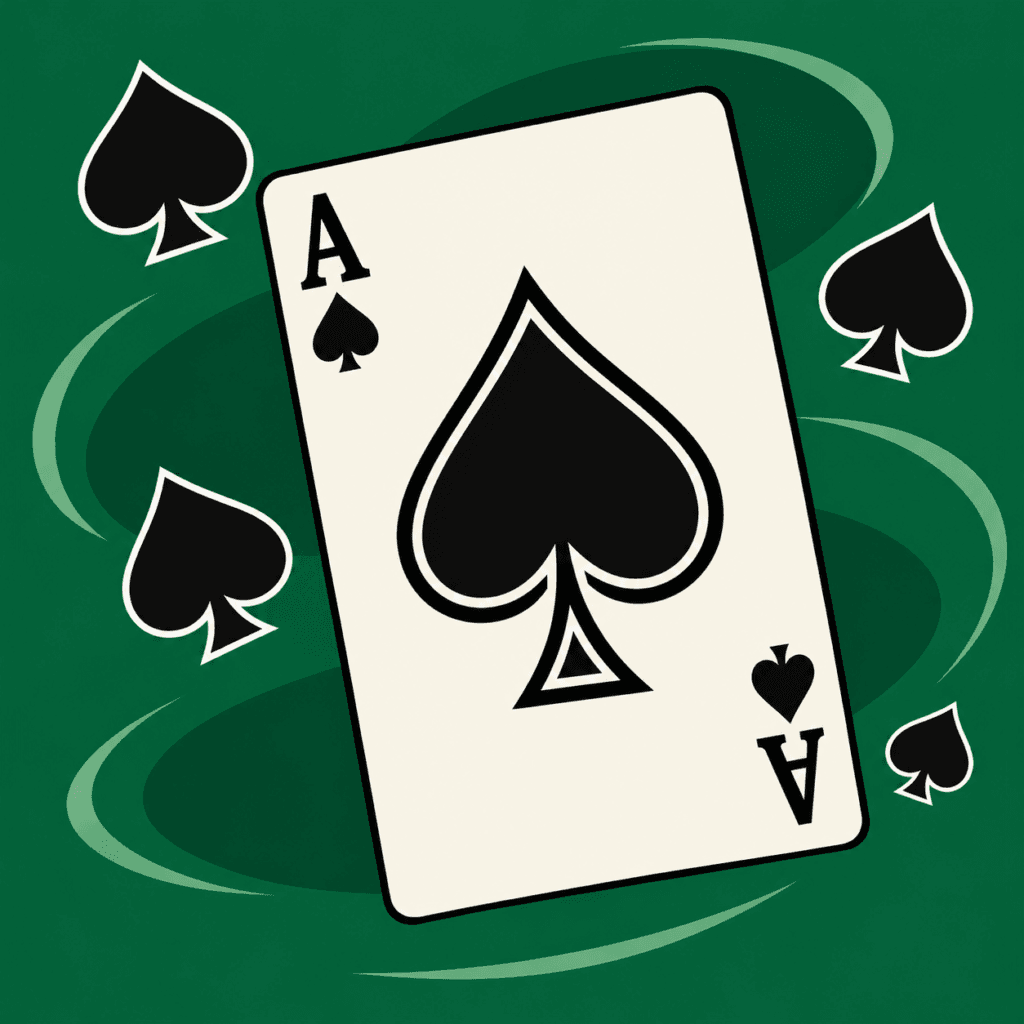
Spades is a trick-taking card game in which players have to predict how many tricks their team can win. The game became popular in the United States during the 1930s and 1940s and has remained a favorite for family gatherings, card nights, and competitive play. Its straightforward rules make it relatively easy to learn, while the combination of bidding, teamwork, and strategy gives experienced players plenty to think about.
The defining feature of Spades is its trump suit. Spades always outrank the other suits, meaning a relatively low spade can beat a high card from another suit. Knowing when to use your spades, when to save them, and how to work with your partner is the key to winning. Traditionally spades is played with two teams of two, although Spades can be played with 2-5+ players. This guide will cover the traditional version.
Whether you are learning how to play spades for the first time or looking to improve your strategy, this guide covers everything you need to know about how to play Spades.
Before starting a game of Spades, gather the following:
Players sit across from their partners, so each team alternates seating around the table.
Cards rank from highest to lowest as follows:
A (ace), K (king), Q (queen), J (jack), 10, 9, 8, 7, 6, 5, 4, 3, 2.
Spades are always trump. This means any spade beats any card from another suit, regardless of that card’s rank.
For example, if a player leads the king of hearts and another player plays the 2 of spades, the 2 of spades wins the trick, provided no higher spade is played later in the trick.
Within the spade suit, the ace of spades is the highest card, followed by the king, queen, and so on down to the 2 of spades.
Choose a dealer, who shuffles the deck and deals all 52 cards face down, one at a time, clockwise around the table.
Each player receives 13 cards.
The player to the dealer’s left makes the first bid and leads the first trick.
Before playing any cards, each player looks at their hand and estimates how many tricks they expect to win during the hand. This estimate is called a bid. The tricky part here is that you cannot look at your partners hand, nor can you communicate with them about your bid. You can only look at your own hand and bid accordingly.
A trick consists of one card from each player. There are 13 tricks for each hand dealt.
Players bid in clockwise order, starting with the player to the dealer’s left. A bid can range from zero to 13 tricks.
If playing partners, each player’s bid contributes to the team’s total bid. For example, if one partner bids 4 and the other bids 3, the team must win at least 7 tricks to meet its combined bid.
Bids are based on the strength of your hand. High cards, particularly aces and kings, can help you win tricks. Spades are especially valuable because they can trump cards from other suits.
Example: You have the ace and king of spades, the ace of hearts, and several other high cards. You might reasonably bid 4 tricks, depending on the rest of your hand.
Your partner’s bid matters, too. If your partner bids 3, your team has a combined target of 7 tricks.
A player may bid nil, meaning they predict they will win zero tricks. Nil is a special bid that can earn a bonus if successful, but it also carries a penalty if the player wins even one trick.
In a standard scoring system:
• Successful nil: The team earns 100 bonus points.
• Failed nil: The team loses 100 points.
The nil player’s partner can still make a regular bid, and the team must try to meet that bid while helping the nil player avoid taking tricks.
Nil scoring can vary between house rules, so agree on the details before starting.
After everyone has bid, the player to the dealer’s left leads the first trick by playing one card face up.
Each player then plays one card in clockwise order. Whenever possible, players must follow suit, meaning they must play a card from the same suit as the first card played.
For example, if the first player leads the 10 of diamonds, everyone who has a diamond must play a diamond.
If a player has no cards in the suit that was led, they may play any card, including a spade.
The trick is won by the highest card in the lead suit led unless a spade is played. If one or more spades are played, the highest spade wins.
The player who wins the trick collects the four cards and leads the next trick. It is good practice to put tricks into neat stacks, so that all players can clearly see how many you have collected.
Spades are the trump suit, but you cannot lead with a spade until spades have been broken unless you only have spades remaining in your hand. Spades are considered broken when a player uses a spade to trump a trick after being unable to follow the suit that was led.
For example, a player leads the 8 of clubs. You have no clubs, so you play the 4 of spades. Spades are now broken, and you have trumped the trick. Once spades have been broken, players may lead with spades on later tricks. Once the hand ends, the spades would need to be broken again for the next hand before it can be played.
The hand continues until all 13 tricks have been played. Players should pay attention to which cards have already been played. The closer a hand gets to the end, the less flexibility you will have with which cards you choose to play. Also, the further along the hand, the more likely players will not have the lead suit and will instead play their trump cards.
Once all 13 tricks have been played, each team counts the number of tricks it won and compares that number with its combined bid.
Teams that meet their bid receive 10 points for every trick bid, plus 1 point for each extra trick. Extra tricks are commonly called bags.
A team that fails to meet its combined bid loses 10 points for every trick it bid.
Here is an example of standard scoring:
Team bid Tricks won Score
6 6 +60
6 7 +61
6 8 +62
6 5 -60
8 8 +80
If your team bids 6 and wins 7 tricks, you earn 61 points: 60 for meeting the bid and 1 for the extra trick.
If your team bids 6 but wins only 5 tricks, you lose 60 points.
Every trick won beyond a team’s combined bid counts as one bag. Bags add points in the short term, but if you collect too many of them, they come with a hefty penalty. A team that accumulates 10 bags loses 100 points. After the penalty, the team’s bag count typically resets to zero.
For example, a team that bids 5 and wins 7 tricks earns 52 points and receives 2 bags. If it later reaches 10 total bags, it loses 100 points.
Some groups use different bag rules or limits, so confirm the scoring system before the first hand.
Nil bids are scored separately from the team’s regular bid.
After each hand, record the scores and deal again. Continue playing hands until a team reaches 500 points.
The team with the higher score at the end wins. If both teams reach or pass the target on the same hand, the team with the highest score wins.
Spades combines card management, probability, and teamwork. You do not need to memorize every card to play well, but a few habits can make a big difference.
Avoid bidding too aggressively just because you have a few high cards. Consider your entire hand, including how many spades you hold and whether you have high cards in multiple suits. Bidding a little low is much less risky than bidding too high.
Consider your high cards and trump. Aces are usually strong because they often win when led. Kings are more dependable when you also have the ace or when the ace has already been played. Low cards may be unlikely to win tricks unless you can use them strategically. Trump cards are an important part of the equation too, but even they can be beat unless its the Ace of spades.
Your partner’s bid helps you estimate how many tricks your team needs. If your partner bids 5 and you bid 3, your team needs 8 tricks.
Avoid taking unnecessary tricks from your partner if your team is already on track to meet its bid. However, if the team is at risk of falling short, you may need to play more aggressively.
Spades are powerful, but using them too early can leave you without trump cards later in the hand.
Consider saving high spades to win important tricks. For instance, playing it on top of your opponents’ spades can derail their plans, as they may have been counting on it to win their tricks. Low spades can be useful for taking tricks when other players are unable to follow suit.
Also, remember that players cannot lead spades before they are broken, unless it’s the only suit a player has remaining. Use that restriction to anticipate which suits opponents may lead.
You do not have to remember every card, but keeping track of the high cards and which suits an opponent or you partner don’t have is important.
If the ace of clubs has already been played, the king of clubs may be able to win a later trick. If several high spades have appeared, lower spades become more valuable.
A nil bid changes the way you approach the hand. Your partner is trying to avoid winning any tricks, so you may need to win tricks that would otherwise go to them.
For example, if your nil-bidding partner is forced to play a high card in a trick, you might play an even higher card to win the trick yourself. At the same time, do not assume you can protect a nil bid in every situation. Your partner’s cards and the order of play will determine what is possible.
Extra tricks earn points, but too many bags can cost your team 100 points. If your team is already comfortably meeting its bid, think carefully before taking unnecessary tricks.
On the other hand, do not let bag concerns cause you to miss your bid. Falling short can cost far more than a single extra trick.
In standard Spades, partners should not exchange information about their hands or make unauthorized signals. Your bids and the cards you play provide the information your partner can use.
Lead suits that suit your hand, notice which cards your partner plays, and use the information available at the table to make decisions.
Spades is an excellent choice for players who enjoy card games with a mix of luck, strategy, and teamwork. Its basic rules are simple enough for beginners to learn, but bidding and partnership play give the game depth beyond simply playing the highest card.
Spades rewards players for thinking ahead. Bidding gives every hand a goal, and the trump suit creates opportunities to win tricks even when your hand is weak in other suits.
Playing with a partner changes the dynamic of the game. With most trick taking games, you only have your own hand to worry about. Having a partner makes the strategy more difficult, yet more rewarding when you successfully coordinate your efforts.
New players may find bidding and scoring confusing at first, particularly when nil bids and bag penalties are involved. A hand can also become frustrating when a team falls short of its bid despite playing well.
High. Every deal presents a different combination of cards, and the decisions made by both teams can dramatically change how a hand unfolds. Spades is especially satisfying when partners anticipate each other’s plays and manage to meet a difficult bid.
Spades is great for players who enjoy traditional card games, trick-taking mechanics, and strategic team play. It is less suitable for groups looking for a purely casual game with little planning or scorekeeping.
Now that you know how to play spades, you may want to try it for yourself. You do not need to purchase a special game set to play Spades. A standard 52-card deck is all you need, making it an easy and inexpensive addition to a family game night or a regular card-game rotation.
If you are building your own collection of tabletop and card games, explore Emerald Eye Games for more game guides, reviews, and ideas for your next game night.
Enjoyed this post? Sign up for our newsletter below to get more game guides, recommendations, tips, and inspiration for your next game night!
Added to cart
Check out our shop to see what's available
Loading coupons...