
Whether you are learning how to play Cribbage for the first time or refreshing your memory, this guide covers the rules, scoring combinations, strategies, and everything else you need to start playing.
Cribbage is a classic card game that combines strategy, arithmetic, and luck. Players compete to be the first to reach 121 points by creating scoring combinations with their cards. Cribbage uses a distinctive pegging board to track scores, making it recognizable even to people who have never played.
The game dates back to 17th-century England and is generally credited to Sir John Suckling, an English poet and gambler. It developed from an earlier game called Noddy and has remained popular for centuries.
Cribbage is traditionally played by two people, although there are variations that can be played with 3-4 people. Its lasting appeal comes from the strategy and meaningful decisions. Players must choose which cards to keep, which to discard, and when to play particular cards during each round. Even a small decision can influence the final score.
Before starting a game of Cribbage, gather the following:
Number of players: 2.
Recommended Age: 10+
Playing time: Around 15–30 minutes.
Equipment: A standard 52-card deck without jokers and a Cribbage board or another way to track points.
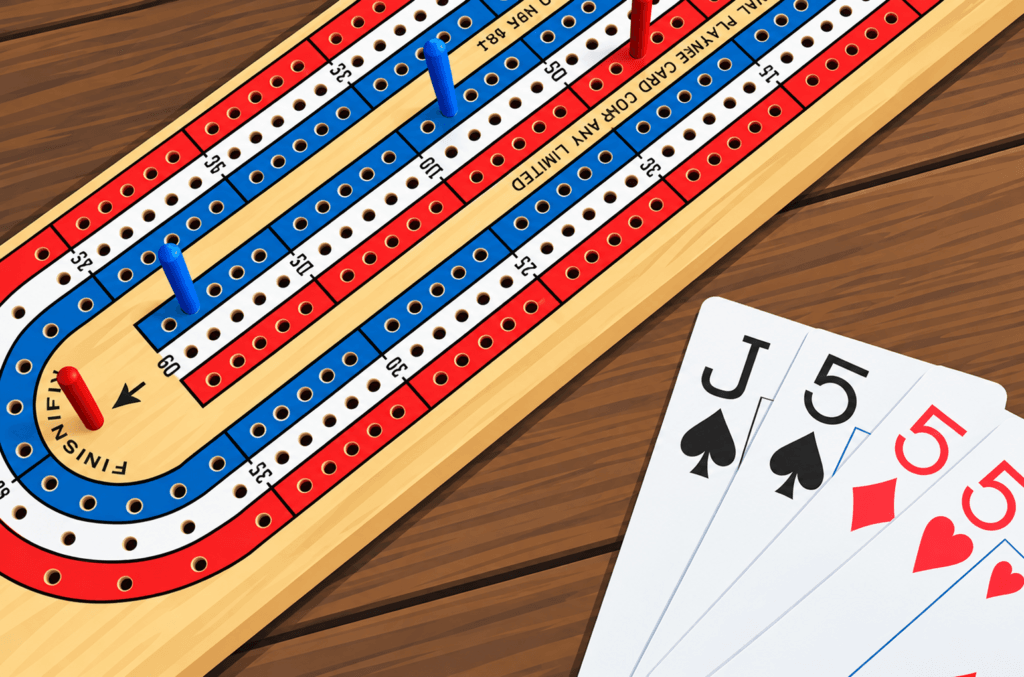
A Cribbage board has holes that stretch around a track for each player’s pegs. Players move their pegs forward as they score points. Most standard boards track scores up to 121.
If you do not have a Cribbage board, you can keep score with paper and pencil. The board is convenient and highly recommended but not required.
Cribbage rules can be intimidating to new players due to number of scoring combinations and “slang”. Here we break it down to make it easy to understand.
The objective is to be the first player to reach 121 points. Players earn points during pegging and when counting their hands at the end of each round.
The dealer also receives a special extra hand called the crib, which can earn additional points. The dealer changes each round, giving both players opportunities to benefit from it.
A player wins as soon as they reach 121 points. You do not need to finish the round or wait for your opponent to count their hand.
Card values are important because several scoring combinations depend on adding card values together.
Ace: 1 point
Cards 2 through 10: Their face value
Jack, Queen, and King: 10 points each
For runs and sequences, cards follow their usual order: Ace, 2, 3, and so on through King. Aces are low and cannot connect to Kings.
For example, Ace-2-3 is a run of three, but Queen-King-Ace is not a run.
To begin, shuffle a standard 52-card deck.
Each player cuts the deck and flips it over to reveal, and the player who cuts the lowest card deals first. If the cards are equal in rank, cut again. If you aren’t familiar with the term, cutting the deck just means taking a chunk off the top.
The dealer shuffles the deck and deals six cards to each player, one at a time.
Each player looks at their six cards and chooses two cards to discard face down into the crib.
The crib now contains four cards and belongs to the dealer. The crib is basically a second separate hand for the dealer to be used only during the scoring phase.
You want to keep cards that work well together in your own hand while considering which cards might help your opponent if they end up in the crib.
When you are the dealer, you may be more willing to discard cards that could score well together in the crib. When you are not the dealer, you generally want to avoid giving the dealer combinations that are likely to score points.
There is no single discard strategy that works in every situation, but learning which cards combine well is one of the keys to improving at Cribbage.
The non-dealer cuts the deck and puts it underneath the rest of the deck. The dealer then flips the top card and keeps it on top of the deck. This is referred to as the starter card. The starter card is used exclusively for the scoring phase and acts as a second shared card between players.
If the starter card is a Jack, the dealer scores two points immediately. This bonus is called His Heels.
During the scoring phase later, there is another Jack-related bonus called His Nobs. If a player holds a Jack that matches the starter card’s suit, that player scores one point. The dealer can also earn His Nobs from the crib if the matching Jack is among the crib’s four cards. These points can stack as the hand and crib are scored separately.
After the starter card is revealed, the non-dealer begins the pegging phase.
Pegging is the part of Cribbage where players take turns laying down cards and scoring points as they go.
Starting with the non-dealer, players alternate playing one card at a time face up. The cards should be played in way that it can be easily identified who played each card since you will need to know that during the scoring phase. Likewise, its important to keep them together so you can keep track of the running total incase you lose track. Put them in a line, but staggers towards the player who played that card. When you reach 31 you start a new chain, but leave all your cards down until after the scoring phase. See the example below:
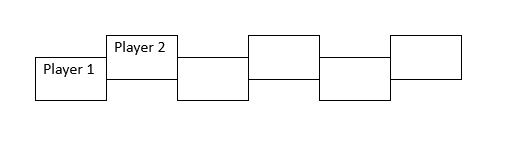
Each player announces the running total of the card values played. The total resets to zero whenever it reaches 31 or neither player can play another card without exceeding 31.
Players cannot play a card if doing so would make the running total exceed 31.
During pegging, players can score points in several ways.
Whenever you score in cribbage, you use your pegs to keep track of points. Each player has two pegs. When you score you take your back peg and move it to your new position. This method shows you what the previous score was. For example, if you score two points, you move your back peg two holes in front of your front peg, which is now your back peg.
If a player plays a card that brings the running total to exactly 15, that player scores two points. It should be announced when you score. For instance, in this situation you would say “2 for 15” so its clear you are scoring two points for reaching 15.
Example:
Player 1 plays a 7, bringing the total to 7. The player announces “7”
Player 2 plays an 8, bringing the total to 15. The player announces “2 for 7 and scores 2 points.
If a player plays a card that brings the total to exactly 31, that player scores two points. As before, they need to announce it and would say “2 for 31”
Example:
The running total is 23.
A player plays an 8.
The total reaches 31, earning that player two points.
After a total of 31, the count resets to zero and pegging phase continues until all cards from both players are gone.
Players can score points by playing 2-4 of the same rank consecutively. Cards of the same rank means cards that have the same number (or letter). Kings and Queens are not considered the same rank even though they score the same. Just as before, these combinations should be announced and scored immediately.
Pair: two points.
Three of a kind: six points.
Four of a kind: twelve points.
Example:
Player 1 plays a 6.
Player 2 plays another 6 and announces “Pair for 2”. Player 2 scores 2 points
Player 1 plays a third 6 and scores six points announcing “3 of a kind for 6” and scores 6.
Player 2 plays the fourth 6 and scores twelve points announcing “4 of a kind for 12”
These combinations must be made with the most recently played cards. A card of a different rank breaks the sequence. For instance a 6>4>6 does not count as a pair of 6’s
A run is a sequence of three or more consecutive ranks. During pegging, a player scores points for creating a run with the most recently played cards, even if those cards were played in a different order. Runs score points equal to the number of cards in a run. So a run of 3 is 3 points and a run of 5 is 5 points. Runs do not have to be in order, but a card not in the run in between would disrupt the run.
For example:
Player 1 plays a 4.
Player 2 plays a 6.
Player 1 plays a 5 and says “Run for 3”
The three cards form a run of 4-5-6, so Player 1 scores three points.
Duplicates can interrupt or complicate runs. For example, a sequence of 4, 5, 5, 6 does not score a run using all four cards because the duplicate 5 prevents them from forming one consecutive sequence. However, the two 5s score a pair.
If a player cannot play a card without taking the running total above 31, they say “Go.” The other player may continue playing cards as long as they can do so without exceeding 31.
When neither player can play another card, the player who played the last card scores one point, unless that card brought the total to exactly 31, in which case the player scores two points instead.
The count then resets to zero, and any remaining cards are played in a new count. Keep all your cards in place and just start a new chain next to it with a small space in between. If a player runs out of cards before the other player, the other player continues playing any cards they can.
Once all cards have been played, the pegging phase ends and the scoring phase begins. their hands.
After pegging, players count their hands using their four cards plus the starter card. The non-dealer counts first, followed by the dealer. The dealer then counts the crib.
When counting a hand, you can earn points for combinations such as 15s, pairs, runs, flushes, and His Nobs.
Each distinct scoring combination counts separately, meaning one card can contribute to multiple combinations.
Any combination of cards that adds up to 15 scores two points.
Examples:
7 and 8 = 15, worth two points.
5, 4, and 6 = 15, worth two points.
10, 2, and 3 = 15, worth two points.
A hand can contain several different combinations that total 15. Score every valid combination separately.
For example, if a hand contains two 5s and a 10, you get 10 points for the 5 and 10 (totaling 15) you also can make 15 with the 10 and the other 5. That gives four points for fifteens. The two 5’s would also score as a pair.
Two cards of the same rank score two points.
Three cards of the same rank contain three different pairs and score six points. Four cards of the same rank contain six different pairs and score twelve points.
Examples:
Two 8s = two points.
Three Kings = six points.
Four 4s = twelve points.
Unlike pegging, where cards must be played consecutively to score pairs or multiples, hand scoring considers all combinations within the hand and starter card.
A run consists of three or more cards in consecutive rank order. Each card in the run scores one point.
Examples:
3, 4, 5 = three points.
6, 7, 8, 9 = four points.
9, 10, Jack, Queen = four points.
Runs can overlap, and duplicate cards can create multiple runs.
For example, a hand containing 3, 4, 4, and 5 has two different runs of three: 3-4-5 using the first 4, and 3-4-5 using the second 4. The hand scores six points for the two runs, plus two points for the pair of 4s, for a total of eight points from those combinations.
A flush occurs when cards in a hand share the same suit.
Four cards of the same suit in your hand score four points.
If the starter card is also the same suit, the five-card flush scores five points. One important thing to note starter card only counts towards a flush is a hand has a flush already. For example, if a starter card is spades and a player has 3 spades and 1 hearts in their hand, this does not count as a 4 card flush.
In the crib, all four crib cards and the starter card must be the same suit to score a flush. Unlike a regular hand, a crib does not score a flush for only four cards of the same suit.
For example, if all four cards in the crib are all hearts and the starter card is a spade, this is worth no points. If the starter card is also a heart, the flush scores five points.
If your hand contains a Jack that matches the suit of the starter card, you score one point for His Nobs.
For example, if the starter card is the 9 of clubs and your hand contains the Jack of clubs, you score one point.
The same rule applies when counting the crib. These points can stack.
After the dealer counts their own hand, they count the crib. The crib is scored using the same basic combinations as a regular hand, including fifteens, pairs, runs, flushes, and His Nobs.
The important difference is the flush rule: the crib only scores a flush if all four crib cards and the starter card are the same suit.
Because the crib belongs to the dealer, both players should think carefully about which cards they discard. The dealer wants to create scoring opportunities in the crib, while the non-dealer generally wants to avoid giving the dealer easy points.
Fifteen: 2 points
Pair: 2 points
Three of a kind: 6 points
Four of a kind: 12 points
Run: 1 point per card
Four-card flush in your hand: 4 points
Five-card flush : 5 points when all cards in hand or crib hand are same as starter card
His Nobs: 1 point when jack in hand or crib matches starter card
His Heels: 2 points for the dealer when the starter card is a Jack
Pegging to 15: 2 points
Pegging to 31: 2 points
Cribbage can also be played with three or four players, although the deal changes.
In a three-player game, each player is dealt five cards and discards one card into the crib. One additional card from the undealt deck is placed directly into the crib, giving it four cards total. The starter card is then cut as usual. Each player keeps four cards.
In a four-player game, players usually form two partnerships, with partners sitting opposite each other. Each player is dealt five cards and discards one card into the crib. The dealer owns the crib, and partners combine their scores on the board.
Rules and dealing procedures can vary slightly by group, so agree on the version you are using before starting.
Cribbage has an element of luck as with any card game, but good decisions can improve your chances of winning. The most important choices involve discarding cards, anticipating your opponent’s plays, and balancing immediate points against future scoring opportunities.
When choosing which cards to keep, look for combinations that can score in several ways.
Cards that are close in rank can create runs, while combinations that add to 15 can provide multiple scoring opportunities. For example, a 5 can work well with a 10, a face card, or other cards that help form 15s.
Do not focus on the highest individual card values as this scores no points on their own. Cards that work well together will score the most points.
Your discards should change depending on whether you are dealing.
When you are the dealer, you may be able to choose discards that improve the crib while keeping a reasonable hand. When you are the non-dealer, avoid discarding combinations that are likely to help your opponent.
Cards such as 5s can be valuable to a crib because they combine with 10-value cards to make 15. Be especially cautious about giving your opponent a 5 unless the rest of your decision makes sense.
Do not play every card simply because it gives you an immediate point. Consider what your opponent might play next and how your card affects the running total.
For example, playing a 5 can be risky if your opponent can respond with a 10-value card to make 15. On the other hand, playing a card that creates a pair or extends a run may help you earn points.
As you gain experience, pay attention to which cards have already been played and which cards your opponent might still hold.
Some pegging totals are more dangerous than others. If your first card played is a 5, your opponent can play a 10-value card to make 15 and score two points. With the abundance of 10 point cards, avoiding bringing the total to 5 or 21 is advisable in most situations.
Learning which cards your opponent could use to reach 15 or 31 helps you make safer plays.
Knowing the scoring combinations without needing to look them up will make the game easier to follow and help you spot opportunities faster.
The more familiar you become with these combinations, the easier it will be to recognize strong hands and make better decisions.
Cribbage is a strong choice for players who enjoy traditional card games with an emphasis on strategy. Learning how to score hands and make smart discards gives the game plenty of depth.
One of Cribbage’s biggest strengths is its variety. The cards change every round, and players must continually adapt their approach. Pegging adds another layer of decision-making because the order in which cards are played can determine whether someone scores a pair, a run, or a total of 15.
Cribbage also benefits from its compact equipment. A deck of cards and a small board are enough for a full game, making it suitable for home game nights, travel, or a quick match between friends.
The main drawback is the scoring system. New players may find it difficult to remember every combination, particularly when counting hands with overlapping runs and multiple fifteens. A scoring reference can help during the first few games, and the rules become easier with practice.
If you are looking for a two-player card game with quick rounds, meaningful decisions, and strong replay value, Cribbage is well worth trying. It is also a good option for families who want to learn a traditional game that can be enjoyed for years.
Cribbage requires just a deck and a cribbage board which are widely available from game stores, toy retailers, and online marketplaces. You can find basic travel sets, traditional wooden boards, and deluxe versions designed for regular play.
Here are some playing cards and cribbage boards you may like:
Playing Cards
Shop our playing cards at Emerald Eye Games
Cribbage Board
Shop Cribbage board at Emerald Eye Games
Shop Cribbage board with pegs on Amazon
If you are building your collection of classic card and tabletop games, explore Emerald Eye Games to find your next game-night favorite. View our store here.