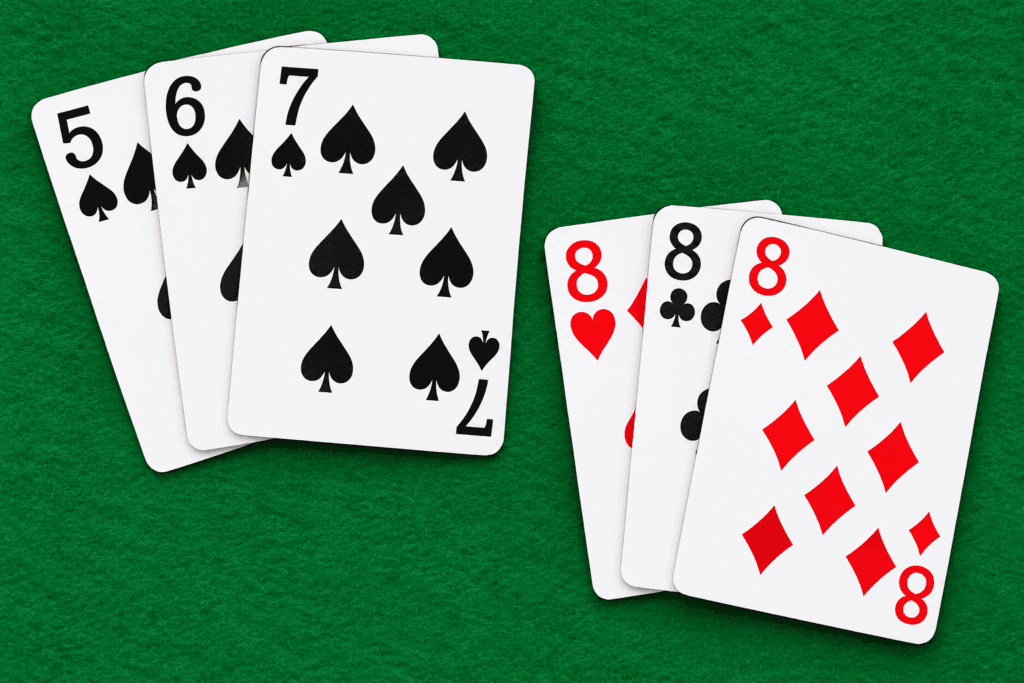
Whether you are learning how to play Rummy card game for the first time or need a review, here’s everything you need to know:
Rummy is one of the most recognizable card games in the world, combining strategy, memory, and a little luck. The objective is to organize your cards into matching combinations, known as melds, while getting rid of the unmatched cards in your hand. Players take turns drawing and discarding cards, trying to form sets and runs before their opponents do.
Although the exact origins of rummy are debated, the game is generally believed to have developed during the 19th century, with influences from older matching and card-melding games. Over time, numerous variations emerged, including Gin Rummy, Indian Rummy, and Canasta. Today, Rummy remains a popular choice for family game nights because it is easy to learn, requires only a standard deck of cards, and offers plenty of opportunities for strategic play.
In this guide, we will cover the rules of traditional Rummy, including how to deal, form combinations, take turns, and determine the winner.
Players: 2–6
Recommended age: 8+
Playing time: 15–30 minutes
Equipment: One standard 52-card deck (without jokers)
Rummy works best with two to four players, although additional players can join. A single deck is generally sufficient for a game of up to six players.
Now that you have what you need, it’s time to learn how to play Rummy. First, here are the basics:
The goal of Rummy is to form valid combinations of three or more cards, known as melds. Players try to use every card in their hand by creating sets and runs. The first player to get rid of all their cards wins the round.
There are two types of combinations in Rummy:
Sets: Three or four cards of the same rank but different suits. For example, 7 of hearts, 7 of clubs, and 7 of diamonds form a valid set.
Runs: Three or more consecutive cards of the same suit. For example, 4, 5, and 6 of spades form a valid run. A-2-3 and Q-K-A are also valid runs, but K-A-2 is not.
Card values are used to calculate points at the end of each round:
Number cards (2–10): Face value
Jacks, Queens, and Kings: 10 points each
Aces: 1 point
Aces can be used as low cards in a run (A-2-3) or as high cards (Q-K-A). They cannot wrap around, meaning K-A-2 is not a valid run. For this guide, aces are worth 1 point when calculating unmatched cards.
Each turn consists of three basic steps:
At the beginning of a turn, a player must draw one card. They can choose either the top card from the face-down stockpile or the top card from the face-up discard pile.
The discard pile allows players to pick up a card they know they need, while drawing from the draw pile keeps their choices hidden from opponents.
After drawing, players can place valid sets or runs face up on the table. This is called melding. Players do not have to lay down combinations immediately and can keep them in their hand to avoid revealing their strategy.
For example, if a player holds the 5, 6, and 7 of hearts, they can place these cards together as a run.
Players may also add cards to existing melds on the table, provided the resulting combination remains valid. This is known as laying off. For example, a player could add an 8 of hearts to an existing 5-6-7 of hearts run.
To finish their turn, a player must discard one card face up onto the discard pile.
Players should try to discard cards that are unlikely to help their opponents while keeping cards that could complete their own combinations.
A round ends when a player gets rid of all the cards in their hand. This is called going out.
To go out, a player must form valid melds with their cards and discard their final unmatched card.
Once a player goes out, the round ends and the remaining players count the points in their unmatched cards. These are commonly called deadwood cards.
In traditional Rummy, the player who goes out earns points equal to the value of the unmatched cards remaining in their opponents’ hands.
For example, if an opponent has a 4, a 9, and a King left in their hand, their unmatched cards total 23 points (4 + 9 + 10).
The player who went out receives those points. The round winner can collect points from all remaining players.
Players can continue playing additional rounds until someone reaches 100 points. The player with the highest total wins the game.
If the draw pile runs out before anyone goes out, shuffle the discard pile (leaving its top card in place) to create a new stockpile.
Although Rummy involves some luck, good decision-making can make a significant difference. Knowing which cards to keep, which to discard, and what your opponents might be collecting will improve your chances of winning.
Avoid committing to a single combination too early. Holding cards that could potentially form multiple sets or runs gives you more opportunities as the game develops. For example, a 7 of clubs could become part of a run or a set, depending on the cards you draw.
Watch which cards other players pick up from the discard pile. If an opponent takes a 6 of diamonds, they may be working toward a set of 6s or a run of diamonds. Avoid discarding cards that could help complete their combinations.
Kings, Queens, and Jacks are worth 10 points each. Holding too many high-value cards can be costly if another player goes out before you. If a card is not helping you form a combination, consider discarding it rather than risking a large point total.
Picking up a card from the discard pile can reveal information about your strategy. Your opponents may recognize the combinations you are trying to build. Sometimes drawing from the stockpile is the better choice, even when the discard pile contains a useful card.
Keeping track of discarded cards can help you make better decisions. If several cards of a particular rank have already been played, the chances of completing a matching set become lower. Memory can be a valuable advantage, especially in longer games.
Sometimes the cards you are collecting simply do not appear. Rather than holding onto an incomplete combination for too long, look for other ways to use those cards. Being flexible can help prevent high-value cards from accumulating in your hand.
Its no surprise how Rummy became as popular as it is. Its straightforward rules make it easy for new players to learn, while the decisions involved in forming melds and managing discards give experienced players plenty to think about.
Easy to Learn: The basic rules can be explained in just a few minutes, making Rummy accessible to players of different ages and experience levels.
Strategic Gameplay: Players must constantly evaluate their hands, anticipate what opponents are collecting, and decide when to keep or discard certain cards.
Minimal Equipment: All you need is a standard deck of playing cards, making it an inexpensive game that can be played almost anywhere.
Good Replayability: The combination of random card draws and changing player decisions means that no two rounds are exactly alike.
Luck Can Play a Big Role: Even experienced players can struggle when the cards they need simply do not appear.
Different Rule Variations: Like most unofficial card games, Rummy has many variations and varying rulesets. Players should establish which version they are using before starting.
Overall, Rummy is an excellent choice for families and casual card players. It is easy to bring to the table, and works well with a variety of group sizes.
One of the best things about Rummy is that you probably already have everything you need to play. Grab a standard deck of playing cards, gather a few friends or family members, and start playing today!
Need a new deck, check these out:
Enjoyed this post? Sign up for our newsletter below to get more game guides, recommendations, tips, and inspiration for your next game night!
Added to cart
Check out our shop to see what's available
Loading coupons...