
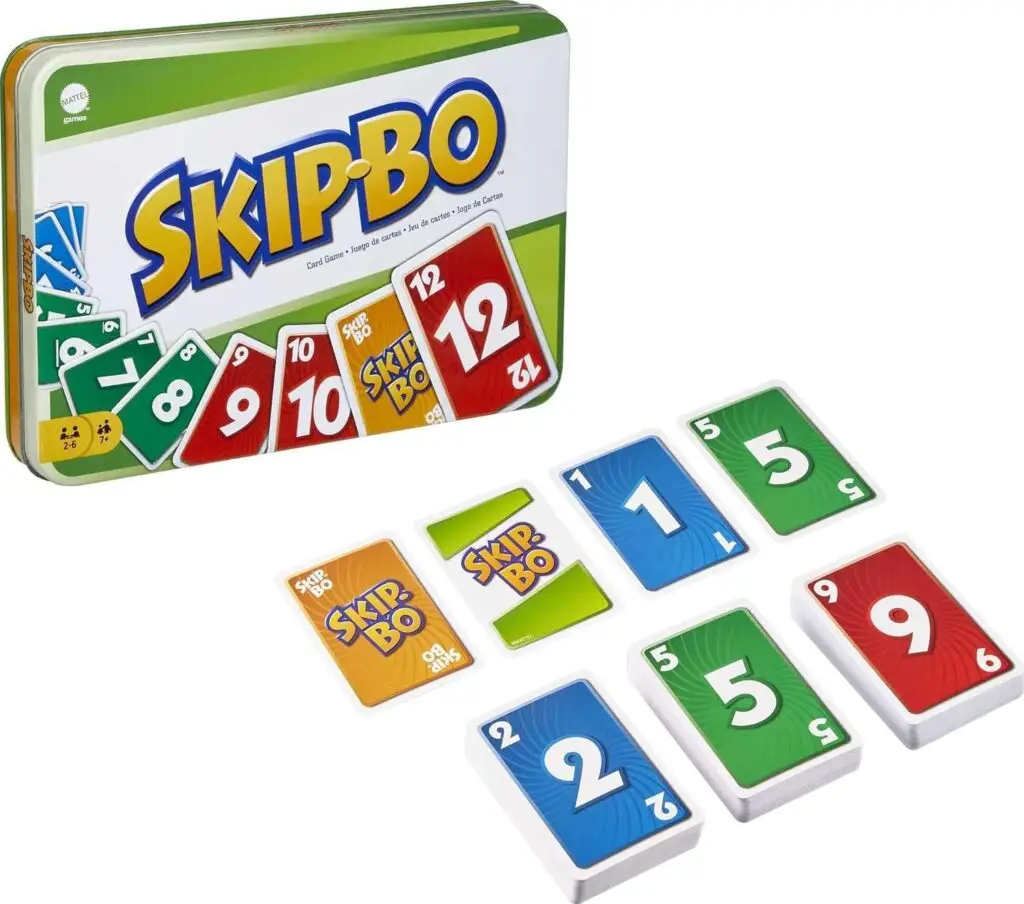
If you enjoy card games that are easy to learn but still give you plenty of opportunities to strategize, Skip-Bo is worth adding to your game night. Skip-Bo is a sequencing game in which players create ascending stacks from 1 through 12, with Skip-Bo cards acting as wild cards.
The main goal is to get rid of all the cards in your Stock pile before your opponents do. Players work together to build up shared Building piles while trying to clear their own personal Stock piles.
The game’s origins go back to 1967, when Minnie Hazel “Skip” Bowman began producing a boxed version of the game in Brownfield, Texas. International Games acquired the game in 1980, and Mattel, makers of UNO and other popular favorites, later acquired International Games in 1992.
So, how do you play Skip-Bo? Let’s break it down.
Players: 2–6
Recommended age: 7+
Playing time: Varies depending on the number of players and whether you play a single round or keep score
What you need: A Skip-Bo card deck
The classic Skip-Bo deck contains 162 cards: 144 numbered cards, with twelve each of numbers 1 through 12, plus 18 Skip-Bo wild cards.
Newer editions can differ in their card count, so check the instructions included with your particular edition if your deck contains a different number of cards.
The objective is to be the first player to get rid of every card in your Stock pile. You do this by playing cards onto one of the 4 shared Building piles in numerical order:
1 → 2 → 3 → 4 → 5 → 6 → 7 → 8 → 9 → 10 → 11 → 12
Once a Building pile reaches 12, it is complete and removed from the table. A new Building pile can then be started. The important part is that you’re not simply trying to get rid of the cards in your hand. Your Stock pile is what matters most. You can play cards from your hand and Discard piles, but the ultimate goal is to work through your Stock pile until it is empty.
There are several different types of piles in the game:
Each player receives their own personal Stock pile at the beginning of the game. The cards remain face down, except for the top card, which is turned face up. You may only play the top card of your Stock pile. This is the pile you are trying to use up, and the first player to do so wins the round.
The remaining cards after the Stock piles are dealt become the shared Draw pile. At the beginning of your turn, you draw cards until you have five cards in your hand.
Building piles are shared by everyone. There can be up to four Building piles in the center of the table at one time. The game starts with all four piles empty until a player has the required card to start one. A Building pile must begin with either a 1 or a Skip-Bo card (the Skip-Bo card is wild and in this instance is being played as a 1) After that, cards must be played in numerical order until the pile reaches 12.
For example:
1 → 2 → 3 → 4 → 5
A 6 can now be played on top.
When a Building pile reaches 12, it is completed and removed from play. That spot can now be used to start a new pile if a player has either a 1 or a Skip-Bo to start it.
Each player can have up to four personal Discard piles. At the end of your turn, you must place one card from your hand onto one of your Discard piles. This signals to the next player that you are done with your turn. Like building piles, all four discard piles are empty at the start of the game. Unlike Building piles, Discard piles do not need to be in numerical order. You can place any card on top of any of your Discard piles. The catch is that you can only play the top card of a Discard pile later. This makes your Discard piles an important part of your strategy.
To set up the game:
For a shorter game, the official rules also provide an optional variation in which each player receives a Stock pile of only 10 cards.
The player to the left of the dealer goes first. Play then continues clockwise.
At the beginning of your turn, draw cards from the Draw pile until you have five cards in your hand. If you already have cards in your hand, only draw enough to bring your hand back to five
Now you can begin playing cards. You can play cards onto the Building piles from three places:
Remember that Building piles must be played in sequence and must be started with either a 1 or a Skip-Bo. If a Building pile currently shows a 4, you can play a 5 on it. Then you could play a 6, 7, 8 and so on.
The Stock pile is the most important pile in the game. Suppose the top card of your Stock pile is a 7, and one of the Building piles currently has a 6 on top. You can play your 7 onto that Building pile. Note: Even if you have a 7 in your hand or discard pile, the best move is generally to play from the stockpile as this is what gets you closer to winning the game. Once you use the 7 from the top of your Stock pile, turn over the next card beneath it. If that card can also be played, you can play it too. This can sometimes create a chain reaction where you remove several cards from your Stock pile during one turn.
Using cards from your hand can help you get the sequence you need to play your Stock pile card. If not, it is still beneficial to use your hand cards to give you more cards that will help you. Remember to check your discard to see if, combined with your hand, there is a path to use your stockpile card.
Your Discard piles give you a way to save cards for later. For example, suppose you have a 3 that you cannot use right now. You might place it on one of your Discard piles rather than keeping it in your hand. Later, when you need a 3, you can play it from the top of that Discard pile. However, be careful about what you place on top of your useful cards. If you put a 9 on top of a 3, you can’t get to the 3 until the 9 is played.
If you play all five cards from your hand during your turn, immediately draw five new cards and continue playing. You can continue doing this whenever you use all five cards in your hand. This is one of the ways a player can have a very productive turn and potentially remove a large number of Stock pile cards. Note that adding a card to the discard pile does not count, as that ends your turn. If you use four of your cards and then put the last one in the discard pile, you must wait till your next turn to draw.
When you can no longer—or no longer want to—make a play, you end your turn by taking one card from your hand and placing it on one of your Discard piles. Then play passes to the next player. You must discard one card to end your turn.
The Skip-Bo card is the game’s wild card.It can represent any number you need. For example, suppose a Building pile looks like this:
1 → 2 → 3 → 4
You need a 5 to continue the pile.
If you have a Skip-Bo card, you can play it as a 5. You could then continue the pile with a 6.A Skip-Bo card can also be used to start a Building pile, since a Skip-Bo can be used as any number and in this case would be used in place of a 1.
Because Skip-Bo cards are so flexible, it can be tempting to play them immediately. Sometimes that’s the right move, but saving one for a difficult situation can be even more valuable.
Eventually, the Draw pile can run out of cards. When that happens, the completed Building piles are shuffled and used to create a new Draw pile. This means completed Building piles aren’t permanently removed from the game. Once they reach 12, they are set aside, but their cards can eventually return to the Draw pile.
The round ends immediately when a player gets rid of every card in their Stock pile. Under the standard rules, that player wins the game. The official rules also provide an optional scoring system if you want to play several rounds:
For a casual family game, you can also simply play one round and declare the person who empties their Stock pile the winner.
Skip-Bo can also be played as a partnership game. In partnership play, teammates can play from both their own and their partner’s Stock and Discard piles. However, players cannot freely discuss their moves while their partner is taking a turn. The game ends when both Stock piles belonging to one partnership have been emptied. This creates a different experience from the standard game because players have access to a much larger collection of cards while still needing to coordinate without giving away too much information.
Skip-Bo is easy to learn, but there is more strategy involved than simply playing the first card you can
Prioritize your Stock Pile. Generally, the priority is Stock pile > Hand > Discard pile. There are excepions to this, but this is a good rule of thumb. Your Stock pile should usually be your first priority. If you have a choice between playing a card from your hand or playing the top card of your Stock pile, playing the Stock pile card is often better because it moves you closer to winning. Likewise, your hand is generally a higher priority than your discard as this will give you more new cards on your next turn, or this turn if you are able to use them all. There are a few situations that the discard pile may be more beneficial to use. You may have a card you need to set you up to use your Stock pile that’s buried underneath another card in the discard. For instance, you may have an 8 in your stockpile with a 6 and a 9 on the board. You have a 10 in your hand, but there is a discard pile that has a 10 on top of a 7. Using that 10 frees up the 7 so that you can play your Stockpile card.
Don’t Waste Your Skip-Bo Cards
A Skip-Bo card can solve a problem that an ordinary card cannot. For example, if you need a 7 but don’t have one, a Skip-Bo can keep your Building pile moving. Try not to automatically use your wild cards simply because you can.
Think About Your Discard Piles
Your Discard piles aren’t just places to put unwanted cards.They can be used to organize cards for future turns. For example, if you have several high cards, you may want to place them in a way that gives you access to useful lower cards later. One strategy that can be affective is to sequence your cards in the discard. For example, you discard a 10. On top of that you play a 9, then an 8. Lets say now your Stock pile has an 11 on top. You can then play the 8 > 9 > 10 and now are able to play your stockpile card. Sequencing discard piles is not always an option, but gives much flexibility to being able to create large sequences when necessary.
Watch Your Opponents’ Stock Piles and Discard Piles
Skip-Bo is not entirely about your own cards. Pay attention to the face-up card on your opponents’ Stock piles. If another player is down to only a few cards, you know they are getting close to winning. That can influence which cards you play and how quickly you complete Building piles. If an opponent has an 8 on their Stockpile, playing a 7 from your hand or discard and then ending your turn is not a wise move. You may even see cards in their discard that could help them use their Stock pile. If you see they have a 6 and 7 in their discard and an 8 on their stock pile, you know that playing a 5 will automatically give them an opportunity to use their Stock pile card.
Don’t Always Complete a Building Pile Immediately
Sometimes completing a Building pile is helpful because it opens another space for a new pile. Other times, the cards currently sitting on the pile may be useful for your next move. The best play depends on what is available in your Stock pile, hand and Discard piles. Also, one again consider your opponents cards. Do they have a low card in their stock pile? If so you may be benefitting them by finishing the pile.
Skip-Bo succeeds because it sits somewhere between a traditional family card game and a light strategy game. The basic rules are simple: draw five, build sequences, manage your piles and get rid of your Stock cards. But once players understand the basics, decisions about when to use a Skip-Bo, how to arrange Discard piles and which cards to prioritize add considerably more depth. It’s also accessible to a wide range of ages. Mattel currently lists the game for 2–6 players ages 7 and up, making it a reasonable choice for a family game night where players may have different levels of gaming experience.
Final Verdict
Skip-Bo is a good choice if you want:
The biggest appeal is that Skip-Bo is easy to explain but doesn’t become completely predictable after a few rounds. The cards you draw determine some of what happens, but good decisions about your Stock pile, Discard piles and wild cards can make a significant difference.
If you’re looking for a card game that can be taught in a few minutes but still gives players plenty to think about, Skip-Bo is a solid addition to game night.
Skip-Bo is available for purchase from many major retailers. Buy it now:
Added to cart
Check out our shop to see what's available
Loading coupons...